Implementation and Funding
Implementation Plan and Table:
The implementation plan balances potential impact, cost, opportunities, need, and community desire to create action items for the future. Priorities span each of the Plan’s guiding principles, and suggest improvements for everything from continued maintenance and planning, greater connectivity network-wide and beyond, increased amenities and accessibility for all, and improved signage, mapping, and wayfinding.
The implementation table includes timelines for work as follows:
- Short-Term goals and actions should take place within 1-3 years and address safety goals like installing signage and maintaining areas, quick wins like mapping an inventory, trailheads, path/trail conditions, minor amenities, and new easements.
- Mid-Term goals and actions should take place within 3-6 years, and address larger maintenance actions, developing new trails and paths, installing restrooms and water fountains, and hiring a staff position.
- Long-Term goals and actions should take place in 6-10+ years, and include long-term goals such as maintenance and new trails and paths.
Goals and corresponding actions may shift between timelines and change categories based on changing needs and funding priorities of an evolving community.
The implementation tables show the overall action items for the Town’s future paths and trails network. It also contains a breakdown of each trail/path type, which can also be explored with greater context within each individual section. Priority rankings are based on a blend of community input, priority levels, “quick wins,” and funding level required (1 being the highest priority, and 10 being the lowest). This plan is heavily dependent on volunteer coordination and participation.
Implementation Tables(PDF, 335KB)
Funding Strategies:
As trails and path networks grow and become highly utilized, diversified revenue source options must also be identified and developed. Nationally, a growing number of municipalities have developed policies and partnership agreements for regional trail and path networks. They have also developed strong partnerships that are fair and equitable in delivering services and maintenance.
In the Town of Oro Valley, some of these policies and management practices are in place or being considered, while others should be considered for future implementation. Some of these sources can potentially be examined as a revenue option to support the Town’s capital and operational needs. The Town will need to continually track trail and path network utilization and conduct an in-depth assessment of the existing system to create a detailed asset management and lifecycle replacement schedule. Managing good data is crucial to making good decisions on revenue development and funding opportunities. Construction of new trail and path segments will be selected as part of future strategic plans.
ADOT
The Arizona Department of Transportation’s (ADOT) Transportation Alternative Grants, grants, and programs help fund eligible transportation projects within Arizona. Working with ADOT to fund certain improvements or extensions such as multi-use paths or Loop segments will be examined for possibilities. Examples include the Naranja Multi-Use Path between 1st Avenue and La Cañada Drive.
General Fund
The Town’s general fund is a key source of financing for incremental improvements such as signage. Examples include Signage for Panorama Trails and partial funding of the Naranja Multi-Use Path between 1st Avenue and La Cañada Drive.
Bond Financing
Municipal bonds can be issued to finance trail and path projects. These bonds are backed by the government and typically repaid using tax revenues or user fees associated with the facility. Bond financing allows for large-scale projects that may require significant upfront investment that address needs identified as unmet community priorities. Examples include the Multi-Use Path on the west side of La Cañada between the Community & Recreation Center and W Canada Hills Drive.
Capital Improvement Plan (CIP)
The Capital Improvement Program (CIP) is a comprehensive, ten-year plan of capital projects that support the continued growth and development of the Town. The Town identifies capital projects as those which:
- Cost $50,000 or more;
- Have an estimated useful life of five years or more; and
- Becomes, or preserves, an asset of the Town.
Capital Improvement Fees
Many parks and recreation systems add a capital improvement fee onto an existing user fee when they develop or enhance major recreation facilities. This is usually applied to amenities like trailheads and special-use facilities. The dollars gained either offset the cost of the capital improvement or the revenue bond that was used to develop or enhance the special use facility. Once the capital improvement is paid off, the fee typically expires and is discontinued. To date, no Capital Improvement Fees have been implemented for trails or paths.
Corporate Sponsorships
Parks and recreation projects can seek corporate sponsorships to secure funding. In exchange for financial support, sponsors may receive branding opportunities, advertising exposure, or other promotional benefits. To date, no Corporate Sponsorships have been implemented for trails or paths.
Developmental Exactions
When future subdivisions and developments are built, a trail or path will be required to be built, including dedication and construction. Examples include the expanded Linda Vista Trailhead parking and the public trails at La Posada.
Government Grants
Parks and recreation projects can often qualify for government grants from federal, state, and local agencies. These grants are typically awarded based on the project's alignment with specific criteria, such as connectivity, safe routes, community impact, environmental sustainability, or economic development. The Town can continue to seek additional grant funding opportunities. Examples include State Grants for path repair and the creation of a new ADA path at the Vistoso Trails Nature Preserve.
Impact Fees
Impact fees are charges imposed on new developments to mitigate the impacts they have on the community, such as increased demand for parks and recreation facilities. These fees are typically collected by the Town and used to fund the construction or expansion of infrastructure like trails and paths. Examples include the Big Wash Trailhead and Linda Vista Trailhead.
Maintenance Endowment Fund
This is a fund dedicated exclusively for a park system’s maintenance and is funded by a percentage of user fees from programs, events, and rentals. The fee is paid by users and is added to a dedicated fund for facility and equipment replacement. To date, no Maintenance Endowment Fund has been implemented for trails or paths.
Partnerships
Partnerships are joint-development funding sources or operational funding sources formed between separate agencies, such as two government entities, a non-profit, a public agency, or a private business and a public agency. Partnerships with Pima County, Catalina State Park, and the State Land Department are ongoing with Oro Valley. Partners jointly develop revenue-producing parks and recreation facilities and may share risk, operational costs, responsibilities, and asset management based on the strengths of each partner. In this approach, entities may provide funding or resources in exchange for specific benefits, such as naming rights, advertising opportunities, or revenue-sharing agreements. Examples include partnership with Marana for the “Move Across Two Ranges” program, and with Pima County for the Loop, as well as the Cañada Del Oro Linear Park.
- Existing partnership agreements should be updated regularly to ensure the purpose of the partnership, what is being provided, and the terms of the agreement are accurate.
- New partnerships should be forged as the Town continues to evolve and modernize the parks and recreation system to align with community needs.
- Ensure that partnerships are fair and equitable to the Town and to the partner with the best interests of the community prioritized.
Preservation Tax
A preservation tax could be put in place to help fund the acquisition of land around scenic vistas and natural resources. Oro Valley’s open space and natural resources were continuously cited as a priority during the community engagement portion of this plan. To date, no Preservation Tax has been implemented for trails or paths.
Philanthropic Donations
Non-profit organizations, foundations, and individual donors can contribute funds to support parks and recreation projects. These donations are often made in the form of grants, sponsorships, or endowments. Philanthropic donations can be essential for funding projects that benefit specific communities or have a social or environmental focus. Examples include the Vistoso Trails Nature Preserve landscape restoration, as well as the installation of trees and benches through the Town.
Regional Transportation Authority
This state-established taxing district within Pima County adopted a 20-year regional transportation plan called RTA Next. This plan improves the transportation network within the greater Tucson region and supports “reduced congestion, improved mobility, enhanced and expanded transit, environmental protections, bicycle and pedestrian improvements, and pavement rehabilitation.” RTA Next will provide funding for transportation improvements within the region. An example includes the partial funding of the Naranja Multi-Use Path between 1st and La Cañada.
User Fees and Charges
Parks and recreation facilities often generate revenue through user fees, membership fees, rentals, concessions, or program charges. These user fees can help offset the operational and maintenance costs associated with the facilities. Examples include user fees and charge for ramadas, fields, and programs through the Parks and Recreation Department.
Volunteerism
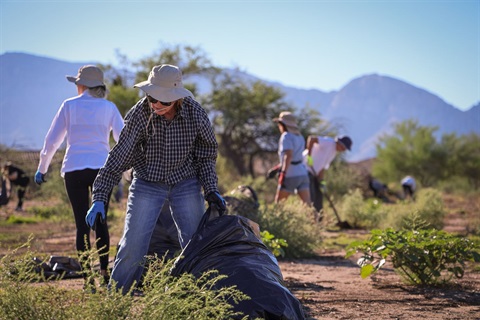
This is an indirect revenue source consisting of individuals donating their time to assist the Town in providing a product or service on an hourly basis. This reduces the Town’s cost to provide services and builds department advocacy and civic involvement. Examples include the “Adopt-a-Trail” program, as well as weed-pull and trash pick-up programs.
OVTrailsConnect Interactive Maps OVTrailsConnect .PDF Format(PDF, 39MB)